
01 · Why this report matters
Adapt the brief to the customer’s questions on each platform
In a December 2025 survey of 600 respondents, 91.8% used at least two content/social apps in the previous week. Connect the information customers need across channels instead of repeating the same creative everywhere.
Source: 明略科技 · 2026中国社交媒体营销趋势报告 · December 2025 usage behavior survey · N=600
Verified public PDF · 64 pages · CMB review date 2026.10.04
02 · Source evidence and English explanation
Read the selected chart on page 6 alongside the explanation below.
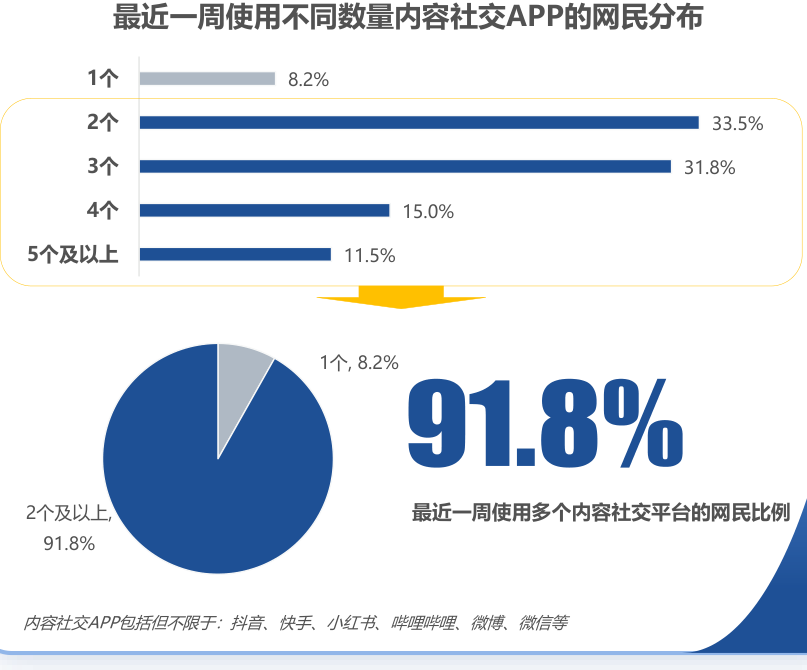
The source chart shows the number of content and social apps used in the previous week: 8.2% used one, 33.5% used two and 31.8% used three. The 91.8% multi-platform figure applies to this survey. It is neither a share of China’s entire population nor a brand’s purchase-conversion rate.
The explanation below accompanies a selected source chart. This article covers part of the report; read the public PDF for the full context and footnotes.
03 · CMB interpretation
What this means for Korean brands
Counting posts by channel can miss how customers move between them. Someone may learn about a product’s use on Xiaohongshu, then check its price and purchase terms on Douyin. Keep product names, descriptions and purchase terms consistent across those steps. Use this report to review channel connections as well as channel selection.
04 · CMB recommendations
Three checks for your next brief
1. Set different questions for each channel
On Xiaohongshu, explain who the product suits. In sales channels, explain the product bundle, price and delivery. On WeChat, answer questions about use and repurchase. This arrangement is CMB’s operational proposal.
2. Maintain clues that customers will recognize
Keep the product name, main image and usage scene recognisable across channels. Adapt length and opening visuals to how people use each channel.
3. View overall performance in conjunction
Record impressions, saves, brand searches, product visits and purchases as separate metrics. Adding channel clicks does not produce a unique customer count.
05 · Application example
Example brief
For a new cream, a Xiaohongshu post could show use before makeup on a workday. State the same product’s size, bundle and delivery terms clearly on the sales page. Prepare answers about the order of use for WeChat inquiries, then compare product visits and questions before and after the test.
CMB developed this planning example. It is not a campaign case or verified result from the source report.
How to interpret the findings
The 91.8% figure alone does not justify operating on every platform. First check your customers’ current route and identify the questions your content does not yet answer.
06 · Original report and sources
Read the public PDF and research conditions
明略科技 · 2026中国社交媒体营销趋势报告
December 2025 usage behavior survey · N=600 · 64 pages
The PDF is a copy of the publisher’s report held in Eastmoney’s public archive. Its archive upload date is not treated as the research period or report publication date. Rights to the report remain with the publisher. This article distinguishes selected source evidence from CMB’s own practical interpretation.