Bottom line: China’s short dramas (短剧) are now mainstream, reaching 718 million users. But 60% of short-drama app users are men, and the most over-represented age group is 41–45. If you budget for short dramas assuming they are a young-female format, you will miss your target. Women’s beauty brands should pick the channel (apps, WeChat or Douyin) and the specific drama first, and test placing products inside the story before buying standard ads.
The data comes from the 2026 Short Drama Industry Insight Report (「2026短剧行业洞察报告」, 29 pages), published on April 8, 2026 by Chinese mobile analytics firm QuestMobile. The data is as of February 2026 and draws on QuestMobile’s app usage database (TRUTH), user attribute database (GROWTH) and brand database (TRUTH BRAND). These figures are based on actual app and mini-program usage, not surveys.
1. The typical short-drama viewer looks more like a man in his 40s
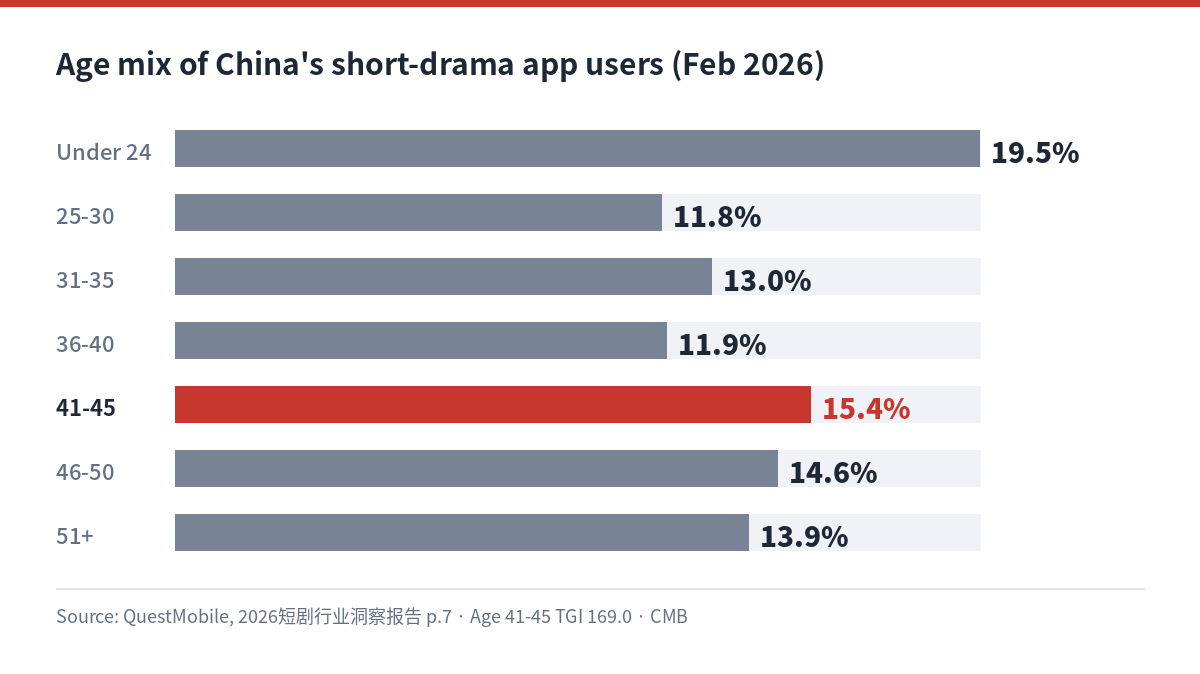
Men make up 60.1% of short-drama app users and 59.2% of those watching through WeChat mini-programs. Excluding the broad under-24 bracket (19.5%), the 41–45 group is the largest at 15.4%, and its TGI of 169.0 (concentration versus all internet users; above 100 means over-represented) is the highest of any age group. Users aged 31–50 together account for 54.9% of app users.
| Metric | Short-drama apps | WeChat mini-programs | Douyin mini-programs |
|---|---|---|---|
| Female share | 39.9% | 40.8% | 51.2% |
| Under 24 | 19.5% | 19.3% | 22.6% |
| Age 41–45 | 15.4% (TGI 169.0) | 11.1% | 9.2% |
| Age 51+ | 13.9% | 31.2% | 22.0% |
| Tier-3 and lower cities | 55.2% | 49.4% | – |
Each channel has a different audience. WeChat mini-programs skew senior, with 31.2% aged 51+, while Douyin mini-programs are the only channel where women are the majority (51.2%). App users aged 50+ grew 50.3% in a year, from 30.97 million to 46.53 million. On the app 河马剧场 (Hema Theater), 59.2% of users are 50 or older.
2. WeChat mini-programs are bigger than apps, and one app holds 90% of the app market
The 718 million figure is the deduplicated total of app and WeChat mini-program users. WeChat mini-programs reach 427 million users (+59.9% year on year), more than apps at 335 million (+74.3%). The two channels are structured in opposite ways.
- Apps are concentrated. Douyin-affiliated 红果免费短剧 (Hongguo) has 303.78 million monthly users, or 90.6% of all short-drama app users. Number two, 河马剧场, has 39.28 million.
- WeChat mini-programs are fragmented and churn fast. The number of mini-programs with over 1 million monthly users rose from 32 to 54. Nine of the top ten launched within the past year. Even the leader, 张扬追剧, has about 74.11 million users.
- Free viewing drives the business. The report says the free model dominates standalone apps and that monetization is expanding beyond ad revenue into brand marketing and overseas markets.
3. Hongguo users watch two hours a day, peaking at 9 p.m.
Short-drama app users spent 22.1 hours per person in February 2026, up from 15.5 hours a year earlier and 5.3 hours in August 2023. Hongguo users average 125.0 minutes a day, three times the 41.7 minutes on second-place 河马剧场.
The daily pattern also differs from standard video apps. Short-drama apps peak at 9 p.m. (23.7%), with another clear spike at noon. Standard video apps such as Tencent Video and iQIYI peak at 7 p.m. (18.3%). In other words, short dramas are binged in short bursts at lunch and before bed.
4. Brands are becoming props in the story instead of buying ads
The report says brands are integrating with short dramas through custom content (定制), e-commerce selling (带货) and IP spin-offs, and highlights five cases.
| Approach | Case | Figures in the report |
|---|---|---|
| Brand-commissioned drama (品牌定制剧) | Synear (思念食品) released its own drama 《穿越后靠汤圆成太子妃》 on Douyin for the 2025 Spring Festival, written around three tangyuan and dumpling products | Brand content reach of about 83.65 million users early in the year |
| Placement in a hit drama + spin-off | Synear placed products in family dinner scenes of Hongguo hit 《家里家外2》 and followed with a spin-off short filmed by the male lead | Reach of 87.07 million users in December 2025 |
| IP spin-off + packaging | Master Kong (康师傅) produced a single-episode spin-off 《辣破诡事录》 with the original cast of 《唐朝诡事录》, making seven spicy noodle SKUs the key to solving cases, and printed character art on packs | 609,000 hashtag interactions (November 2025) |
| Livestream on the drama set | Chinese beauty brand Marubi (丸美) warmed up with a custom “小剧场” spin-off before a hit drama’s new season, then moved its Douyin Mall livestream onto the drama’s main set, with cast members selling in character | Reach up from 22.23 million to 49.49 million (+122.7%); interactions up from 543,000 to 2.092 million (+285.3%), January to February 2026 |
| Shoppable drama | Kuaishou’s 星芒短剧 made exclusively sponsored dramas with Meituan and JD.com, with links under the video leading to Meituan group-buy pages and JD product pages | Seven JD dramas released in rotation from October 24, 2025 for Singles’ Day |
The Marubi case is the most useful for beauty marketers. Rather than producing a new drama, the brand borrowed an existing drama’s world and cast, with a built-in fan base, for a single livestream. For Master Kong, under-24s made up 32.0% of brand users (TGI 150.5) in November 2025, the month of the collaboration.
What Korean brands should change first
The following are CMB recommendations, adapting the report’s data to Korean consumer brands.
| Action | How |
|---|---|
| 1. Pick the channel that matches your target | For beauty aimed at women in their 20s and 30s, start with Douyin mini-programs, where 51.2% of users are women. For products aimed at men 40+, health foods or gifts for parents, short-drama apps and WeChat mini-programs are actually a good fit. |
| 2. Keep app spend simple and Hongguo-first | Hongguo holds 90.6% of short-drama app users. Prove results there before spreading budget across smaller apps. |
| 3. Keep mini-program deals short | Nine of the top ten WeChat mini-programs are less than a year old. Test by episode or by short period rather than signing long contracts. |
| 4. Schedule around noon and 9 p.m. | Time drama-linked ads, livestreams and KOL posts around the 9 p.m. peak and the lunch hour. |
| 5. Ride an existing hit before commissioning your own | Starting with a spin-off or livestream tied to a drama that already has fans, as Marubi did, carries less risk than a custom drama. Check first that the drama’s audience matches your target. |
| 6. Connect the screen to checkout | As in the Kuaishou–JD case, write a direct product-page link into the contract and time the release to sales events such as 618 and Singles’ Day. |
Caveats
- The 718 million figure only covers apps with over 100,000 monthly users and WeChat mini-programs with over 1 million. Short dramas watched inside the Douyin and Kuaishou apps are not included.
- The data covers a single month, February 2026. Because the 2026 Spring Festival fell in February, usage time and brand figures may be higher than usual (CMB interpretation).
- TGI baselines differ by channel: all internet users for apps, all WeChat mini-program users for WeChat, and Douyin app users for Douyin mini-programs.
- Brand case figures measure social reach and interactions, not sales or ad spend. Synear sells tangyuan and dumplings, so winter and Spring Festival seasonality is mixed into its numbers.
- The senior segment is labeled “50+” in one chart and “51+” in another. Marubi is the only beauty brand case in the report.