Bottom line: China’s MCNs (influencer agencies) have split into two kinds: those that make money from livestream commerce and those that make money from brand ad deals (商单). They are good at opposite things. On top of that, eight in ten MCNs saw flat or falling profit margins in 2025. Before signing, Korean brands should ask less about “which creators do you have” and more about “where does your revenue come from” and “what are your payment terms”.
The source is the 2026 China MCN Industry White Paper published in April 2026 by TopKlout (克劳锐), a Chinese influencer data firm. Between December 2025 and April 2026, it collected 518 responses from MCN founders, CEOs and director-level managers through online surveys and on-site visits. Pure entertainment-livestream guilds (秀场直播) were excluded; MCNs running livestream commerce were included. All figures below are self-reported by MCNs and refer to 2025.
1. Commerce MCNs and ad-driven MCNs earn their money in different places
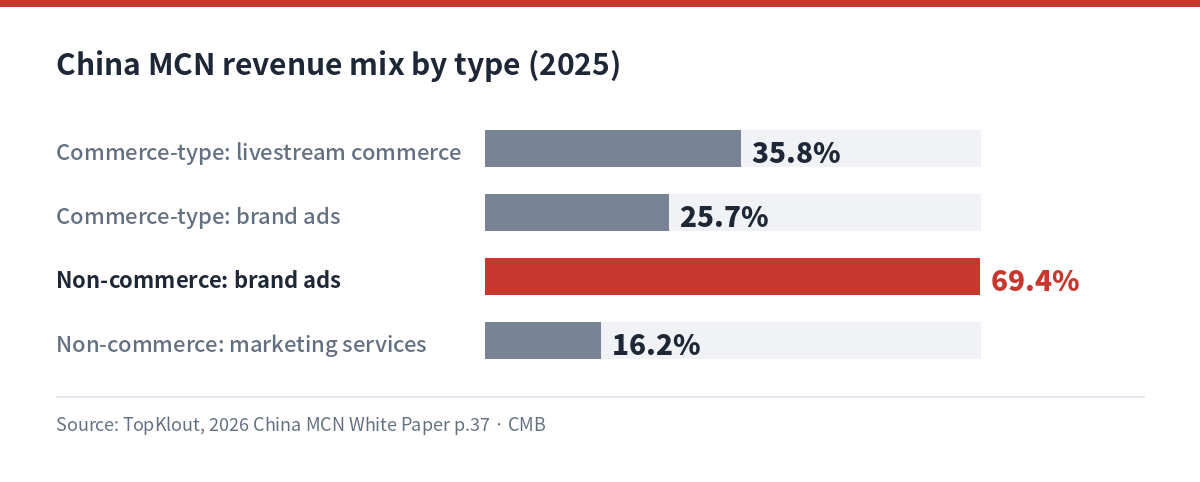
The report splits MCNs into commerce-type (电商型) and non-commerce-type (非电商型) and shows their revenue mix. For commerce-type MCNs, livestream commerce ranks first, but brand ads still bring in a quarter of revenue. For non-commerce-type MCNs, about 70% of revenue comes from brand ads, while livestream and content commerce combined make up only about 10%.
| Revenue line | Commerce-type MCN | Non-commerce-type MCN |
|---|---|---|
| Brand ad deals (广告商单) | 25.7% | 69.4% |
| Livestream commerce (直播电商) | 35.8% | About 10% combined |
| Content commerce (内容电商) | 12.8% | |
| Marketing services (营销服务) | 8.2% | 16.2% |
| Overseas business | 7.6% | 2% or less |
The report describes non-commerce MCNs as “deep partners for brand marketing” and commerce MCNs as players building out from a livestream base into overseas and content commerce. In other words, the agency you hire for 种草 (seeding, word-of-mouth content) and the one you hire to sell are not the same.
2. Livestreaming is now table stakes, but 2026 bets are on ads
- The share of MCNs naming livestreaming as a core content format rose from 45% in 2023 to 70.2% in 2025 (p.32). The report says brands now put results (效) first, so buying ads and livestreams together has become the norm (p.9).
- For livestream selling, Douyin dominates at 90.1%, followed by Xiaohongshu (47.6%), WeChat Channels (视频号, 23.1%) and Taobao Live (19.2%) (p.26).
- Yet for 2026, MCNs named brand ad deals (53.0%) and marketing services (30.1%) as priority businesses, with livestream selling at only 20.5% (p.45). In the report’s words: hold the ad base, and be “rational” about livestreaming.
3. Douyin is the sales engine; Xiaohongshu is where brands want to be
| Metric | Douyin | Xiaohongshu | WeChat Channels |
|---|---|---|---|
| Average share of MCN operations, 2025 | 43.8% | 34.6% | 8.9% |
| MCNs rating future potential as high | 58.4% | 67.5% | 55.4% |
| Top reason for choosing the platform: “brands value it more” | 43.5% | 60.7% | – |
The report calls Xiaohongshu “a must for brand seeding.” But brands prefer mass seeding through mid- and small-tier (腰尾部) KOLs, which puts a premium on an MCN’s roster size and execution speed. It also notes that leading MCNs are growing on Xiaohongshu while smaller ones face low deal values and fierce competition (p.13). Platform expansion has largely stopped: 54.2% of MCNs entered no new platform in 2025, and among those that did, WeChat Channels was the top pick at 24.1% (p.25).
4. Eight in ten MCNs saw margins stall or shrink
- Only 22% of MCNs improved their profit margin in 2025; 41% were flat and 37% declined. In 2023, 34% had improved (p.43).
- Top external challenges: more competitors in the same niche (41.0%), finding new growth businesses (36.1%) and rising brand demands (33.7%). The top internal challenge was surging labor costs (34.9%) (p.49).
- As brand budgets shift toward smaller KOLs, one MCN case study describes dropping high-priced genres in favor of lifestyle vlogs (p.71). Another MCN focused on mid-tier KOCs summed up client spending as “smaller, more scattered orders at lower prices” (单更散、价更低) (p.119).
- The No. 1 growth plan for 2026 is “strengthening the business development team” (51.4%) (p.44). Expect more aggressive sales pitches from MCNs.
5. Chinese MCNs are growing abroad, but it is still a side business
MCNs that have gone overseas use TikTok (87.7%), Instagram (75.6%) and Facebook (50.8%) most (p.27). Overseas-related items add up to more than 27% of 2026 priority businesses (p.45). Even so, the report still calls overseas business “a supplementary option” (p.36). The direction is clear, though: MCNs want to win local brands’ marketing budgets, not just serve Chinese brands abroad, and the report advises focusing on one or two markets with local teams and local creators (p.112). Developed markets such as Japan attract MCNs with strong content production and brand-service capabilities (p.14).
What Korean brands should change first
The recommendations below are CMB’s, adapting the report’s findings to how Korean brands choose and contract Chinese MCNs and agencies.
| Action | How |
|---|---|
| 1. Ask for the revenue mix before the proposal | Ask what share of revenue comes from brand ads versus livestream commerce. For seeding and awareness, pick an ad-driven MCN; for sales, a commerce MCN. If one agency does both, check that separate teams handle each. |
| 2. Split KPIs by platform | Measure Xiaohongshu on data delivery such as reach and hit-post rate, and Douyin on sales and ROI. Do not bind both platforms to one KPI in one contract. |
| 3. For Xiaohongshu mass seeding, verify execution capacity | Since mass seeding through smaller KOLs is the norm, get the number of directly signed accounts, monthly execution capacity and a sample report format before signing. |
| 4. Write payment terms carefully | Many MCNs are under margin pressure. Keep upfront payments low, pay in stages, and check whether the MCN pays its creators on time (one MCN in the report even promises compensation to creators for late payment). |
| 5. Test WeChat Channels small | It is the platform MCNs entered most, but some MCNs say deal flow is “below expectations” (p.84). Start with a single test, not an annual contract. |
| 6. Judge “overseas service” pitches by local teams | If a Chinese MCN offers services in Korea or Japan, check for local staff and signed local creators, and how many markets it actually focuses on. |
Caveats
- All survey figures are self-reported by MCNs. Brands were not surveyed, so “what brands want” reflects MCNs’ perceptions. The size and type breakdown of the 518 responses is not disclosed.
- The report contains no MCN fee or KOL rate tables. Pricing appears only as responses such as “agency fee pressure” (14.5%) or “low deal values” and in case descriptions.
- Korean or other foreign brands are not analyzed separately. Applying the findings to Korean brands is CMB’s interpretation.
- Some labels in the non-commerce revenue chart are ambiguous in order, so livestream and content commerce are shown only as a combined figure. Multiple-choice questions sum to more than 100%.
- TopKlout runs influencer value rankings and copyright management, and the MCN case studies in the report were selected by TopKlout.
Source: TopKlout · 2026中国内容机构(MCN)行业发展研究白皮书 (PDF, 145 pages)