On 27 November 2026 CMB put the same five prompts into Doubao (豆包), DeepSeek and Kimi web chat. Kimi was run in its default “快速” mode; “进阶” was not used. The detailed DeepSeek figures and official API prices for Qwen and Doubao are in “China AI marketing guide: a DeepSeek test and official API prices”.
The same prompts, on the same day, in three web chats
The date was 27 November 2026. Doubao’s screen was labelled “豆包工作”, and no model name was shown. “自动” was selected to the right of the input box, and this screen did not show a button for turning web search (联网搜索) on or off. DeepSeek was used at chat.deepseek.com, with web search (智能搜索) off except for the regulation query. Kimi was used at kimi.com. The input bar showed “快速 / 进阶”; the default, “快速”, was left unchanged. No web-search toggle was visible on the Kimi screen either.
The product brief was the same as in part 1: a fictional sunscreen invented for the test, “舒缓修护防晒霜 (Calming Relief Sun Cream)”, SPF50+ PA++++, 50 ml, 159 yuan, fragrance-free, with centella extract, panthenol, ceramide NP and zinc oxide, described as suitable for sensitive skin on a daily commute. The prompt asked for three Xiaohongshu notes — a first-person review, an ingredient explainer and a comparison — each with a title, body and topic tags (#), and told the model not to use absolute or exaggerated wording such as “最”, “第一”, “首个”, “顶级” or “100%”. The full prompt is in part 1.
One condition should be stated up front. DeepSeek and Doubao received the Douyin-script and Tmall-title prompts in the same conversation as the Xiaohongshu notes. Kimi was given a new conversation for each prompt, so those two requests did not include the earlier product details (name, SPF, ingredients, price). Kimi itself noted “没看到上文的具体产品信息” and wrote as if for a generic Korean sunscreen. The script and Tmall titles are therefore not a same-condition comparison across the three services.
All three kept the format; titles, tags and product facts were placed differently
All three services returned three notes, each with a title, body and topic tags. The copied answers ran to 1,955 characters for Doubao, 1,779 for Kimi and 1,638 for DeepSeek, with no sign that the text had been cut off.
| Item | DeepSeek | Doubao | Kimi |
|---|---|---|---|
| Test date | 27 November 2026 | 27 November 2026 | 27 November 2026 |
| Screen | chat.deepseek.com, no model name. Web search (智能搜索) was off for this task | “豆包工作”, no model name. “自动” selected; no 联网搜索 toggle on this screen | kimi.com, no model name. “快速” ( “进阶” not used); no 联网搜索 toggle on this screen |
| Title, body, tags | All three notes | All three notes | All three notes |
| Topic-tag counts | 8, 8, 8 | 6, 7, 6 | 7, 8, 7 |
| English product name | Calming Relief Sun Cream in all three notes | Not used in the reply | Not used in the reply |
| Size and price | 50 ml and 159 yuan in the first-person and comparison notes | 50 ml and 159 yuan in the comparison note only | 50 ml and 159 yuan in all three notes |
| “最” | Twice in the body (最近, 最终) | None | None of the five listed words. “极致裸感” once |
| “第一” | None | Twice in the body (第一感觉, 第一次用) | None |
| Unsolicited add-on | A short preface that the notes avoided absolute wording and were for a fictional-product test | A four-line “发布前提醒” at the end | A one-line note on advertising-law disclosure and evidence for “修护” and “舒缓” |
The first-person notes invented different scenes; the ingredient and comparison notes used different frames
The first-person titles were “敏感肌换季通勤防晒,我的真实使用记录” (Doubao), “敏感肌通勤防晒实测|清爽不黏腻的舒缓修护防晒霜” (DeepSeek) and “敏感肌的通勤防晒终于找到了😭 上脸像涂乳液一样舒服” (Kimi).
Doubao invented scenes that were not in the brief: a previous product that tightened in the afternoon and pilled under a mask, a first sensation on the face that was “clinging” rather than “dewy”, a commute from 8 a.m. to 6 p.m. with no reapplication and no redness on the cheeks, and slight pilling on the sides of the nose during a weekend hike. It did not put the SPF value, the price or the English product name in this note.
DeepSeek used a “用了一周多” (used for more than a week) frame and put SPF50+ PA++++, 50 ml, 159 yuan, the English product name and the main ingredients into the first-person note. Kimi wrote “用了两周”, added a walk of 40 minutes in the sun with no burn, and put the SPF value, 50 ml and 159 yuan in this note. All three wrote as if they had used a product that does not exist, so the scenes need checking before anything is posted.
The ingredient-note titles were “拆开成分表看这支防晒,它做的是什么组合” (Doubao), “成分党看过来|这支防晒霜的成分思路拆解” (DeepSeek) and “一支防晒为什么要加积雪草?看懂这支防晒的成分思路” (Kimi). All three described zinc oxide, centella extract, panthenol and ceramide NP. The comparison titles were “物理防晒和一般防晒怎么选?我按肤质分了四类” (Doubao), “一般防晒 vs 舒缓修护防晒霜|什么人更适合这支?” (DeepSeek) and “物理防晒vs化学防晒怎么选?这支更适合谁,一篇说清楚” (Kimi). Doubao listed four types of people the product might suit and three situations where it might not. DeepSeek framed the product as a middle path. Kimi split mineral and chemical filters, and under “可能不太适合” included “追求零泛白、极致裸感的人群”.
“第一” and “极致裸感” sat outside the banned-word list, and need to be read in context
The prompt asked the models not to use “最”, “第一”, “首个”, “顶级” or “100%”. In Doubao’s reply, “最” did not appear. “第一” appeared twice in the body. One line, in the first-person note, was “上脸的第一感觉不是“水感”,而是“贴””. The other, in the ingredient note, was “第一次用建议先在耳后或下颌线做小面积试用”. Neither the three titles nor the topic tags contained “第一”.
As part 1 recorded, DeepSeek’s titles and tags also avoided those five strings, while the body used “最” twice: “最近换季,脸颊容易泛红” (最近) and “涂抹量和手法会影响最终效果” (最终). Kimi’s reply did not use the five listed words, but the comparison note included “极致裸感” in the “可能不太适合” list. The reply also opened by saying it had “已规避绝对化用语”. A simple word filter would miss phrasing of this kind. The absence of “第一”, or of “最”, is not enough to say there were no exaggerated expressions at all.
Doubao appended an unsolicited pre-publish reminder
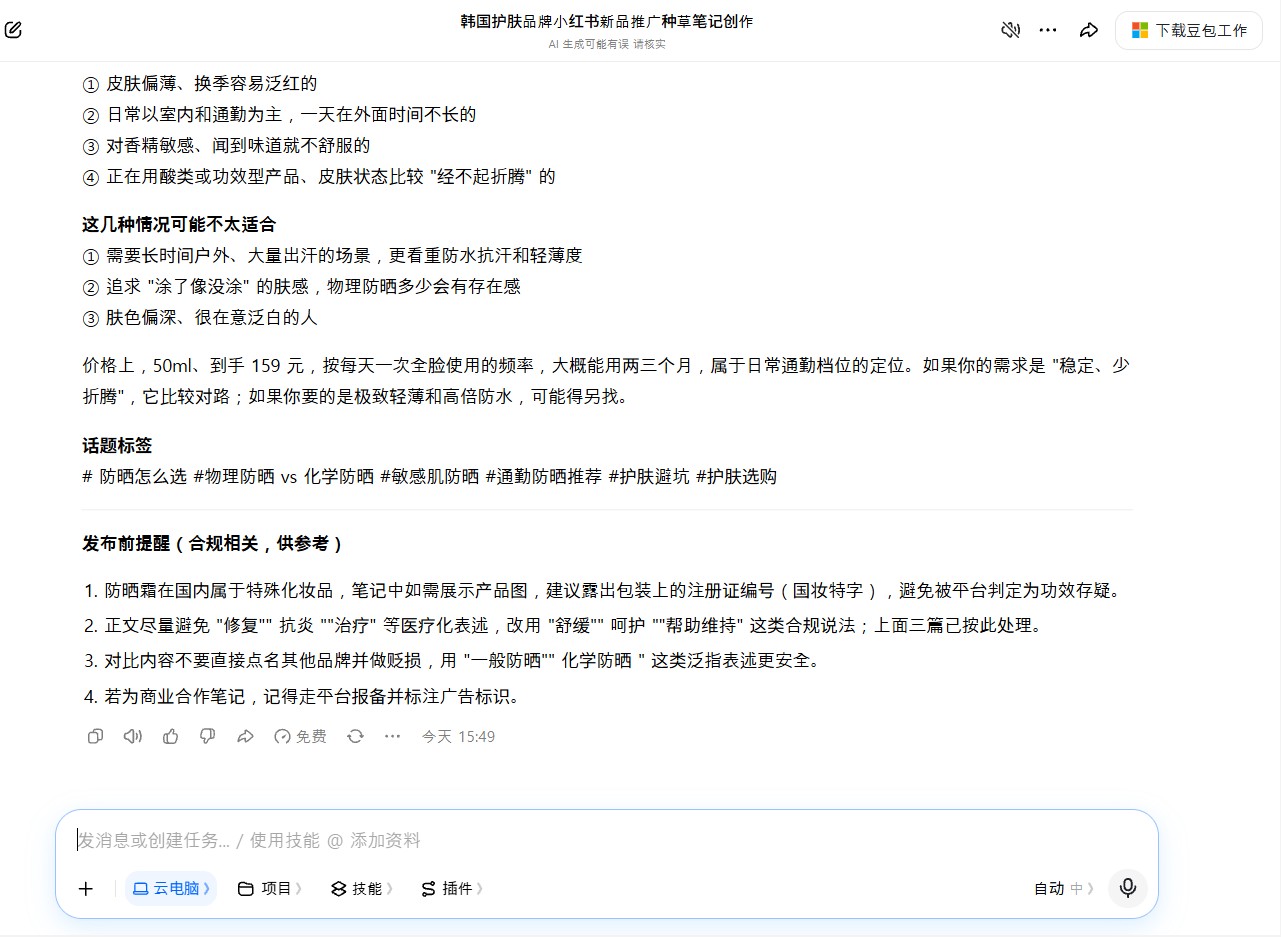
After the three notes, Doubao added a block it had not been asked for: “发布前提醒(合规相关,供参考)”, in four lines. It said sunscreens are special cosmetics in China, so a product photo should show the registration number on the pack (国妆特字); that medical wording such as “修复”, “抗炎” and “治疗” should be avoided in favour of “舒缓”, “呵护” and “帮助维持”; that comparison copy should not name and disparage other brands, and should use general terms such as “一般防晒” or “化学防晒”; and that commercial collaboration notes should be filed with the platform and marked as advertising.
Kimi also added an unsolicited line after the three notes: if the copy is posted on Xiaohongshu, advertising law requires collaboration to be disclosed, and wording such as “修护” and “舒缓” needs supporting test evidence. DeepSeek did not add a pre-publish compliance block. It opened instead with a short preface that the notes were meant for a fictional-product test. Claims that the drafts have “already been handled” or that absolute wording has “already been avoided” still need a human check.
The later tasks diverged on review matches, character counts and how sources were shown
After the three Xiaohongshu notes, CMB also put the same 50-review classification, three Tmall titles, 30-second Douyin script and sensitive-skin claim regulation search from part 1 into all three services. The DeepSeek detail is also in part 1.
| Item | DeepSeek | Doubao | Kimi |
|---|---|---|---|
| Prompt conditions | The script and title prompts were entered in the Xiaohongshu conversation | The same (continued in the Xiaohongshu conversation) | A new conversation for each prompt. The script and title requests had no earlier product details, so those two items are not a same-condition comparison |
| 50-review match | 48/50 | 49/50 | 47/50 |
| Mismatches | No. 19 (correct 混合 → 中性), No. 27 (correct 负面 → 中性) | No. 9 (correct 中性 → 正面) | No. 30 (correct 正面 → 中性), No. 48 (correct 正面 → 中性), No. 49 (correct 中性 → 负面) |
| “最”, “第一”, “首”, “顶级”, “100%” in the three Tmall titles | None in the titles | None in the titles | None in the titles. Title 3 contains “美白” |
| Title character counts | Written as about 27, 28 and 28; actual counts were 28, 30 and 35 | Written as 27, 24 and 24, matching the actual counts | Written as about 17, 18 and 18 Chinese characters; actual Han characters were 18, 19 and 20, and full character counts were 31, 25 and 26 |
| 30-second Douyin script | Kept a six-row “时间段|画面|口播文案” table | Kept the same six-row table | Kept the same six-row table. The spoken lines include “必须吹爆”, “闭眼入” and “韩国人手一支” |
| Regulation-search sources | Six citation links (four unique URLs) | 23 in-text source marks (14 unique sources, mostly government sites; no URLs shown) | 12 links (12 unique URLs, addresses readable, three government sites). Documents from 2010 and 2020 were mixed in |
On the 50 reviews, Doubao matched 49, DeepSeek 48 and Kimi 47; Kimi’s count table had to be retotalled
The correct labels are 18 正面, 13 负面, 10 中性 and 9 混合. These 50 items were written for the test; they are not real reviews.
Doubao matched 49 and missed only no. 9. The line was “和描述的一样,容量和日期都没问题.” The correct label is 中性; Doubao marked it 正面. DeepSeek matched 48 and marked both no. 19 (混合) and no. 27 (负面) as 中性. Kimi matched 47 and missed no. 30 (“赠品小样很实用,正装还没开.”, correct 正面 → 中性), no. 48 (correct 正面 → 中性) and no. Kimi correctly labelled the items DeepSeek missed (19 and 27) and the item Doubao missed (9).
The count table Doubao added at the end (19 正面, 13 负面, 9 混合, 9 中性) matched its own labels. The labels Kimi actually applied were 16 正面, 14 负面, 11 中性 and 9 混合, but the count table at the end said 18 正面, 14 负面, 11 中性 and 7 混合. The total is still 50, yet the table does not match the labels. Totals the model writes should be counted again by a person, not copied as-is.
On the three Tmall titles, only Doubao’s stated character counts were accurate
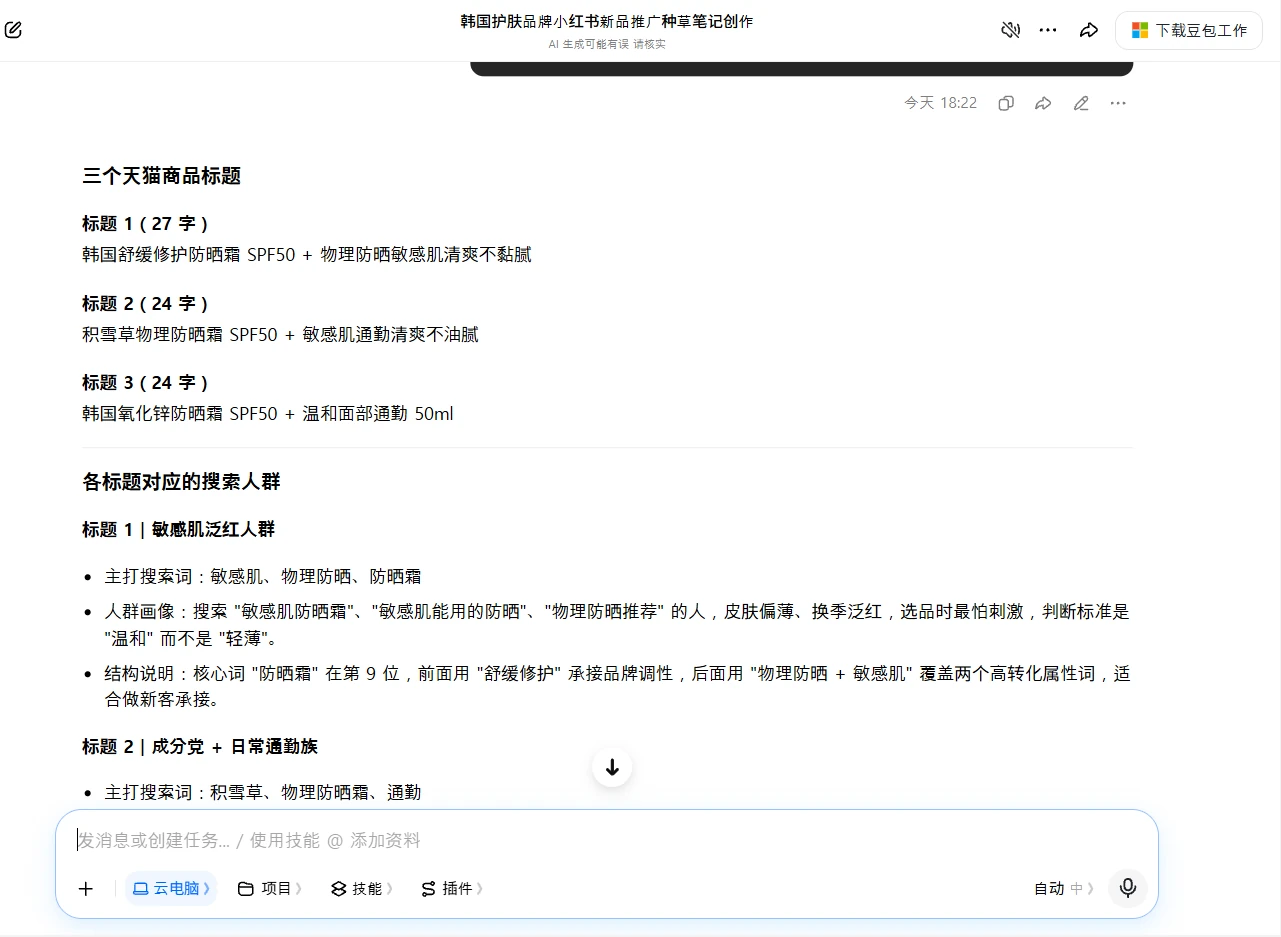
All three models returned three titles. None of the titles contained “最”, “第一”, “首”, “顶级” or “100%”.
Doubao’s titles were “韩国舒缓修护防晒霜SPF50+物理防晒敏感肌清爽不黏腻” (27 characters), “积雪草物理防晒霜SPF50+敏感肌通勤清爽不油腻” (24) and “韩国氧化锌防晒霜SPF50+温和面部通勤50ml” (24). The counts written in the reply matched the actual character counts. DeepSeek labelled its titles “about 27”, “about 28” and “about 28” characters, but the actual counts were 28, 30 and 35.

Kimi’s titles were “韩国防晒霜SPF50+ PA++++清爽不油腻油皮学生军训适用”, “韩国敏感肌防晒霜温和舒缓高倍防护SPF50+不闷痘” and “韩国美白防晒霜素颜提亮隔离防晒二合一PA++++通勤”. The reply labelled them “about 17, 18 and 18 Chinese characters”, but the Han-character counts are 18, 19 and 20, and the full character counts are 31, 25 and 26. Kimi received this prompt in a new conversation, without the earlier product details, and said in the reply that it had assumed a generic product because no brand or ingredients were given.
Kimi’s third title contains “美白”. Article 16 of the Regulations on the Supervision and Administration of Cosmetics (State Council Decree No. 727) classifies cosmetics used for hair dyeing, perming, spot-fading and whitening (祛斑美白), sun protection or anti-hair loss, and cosmetics that claim a new efficacy, as special cosmetics. Article 17 says special cosmetics may be manufactured or imported only after registration with the State Council’s drug regulatory department. The fictional sunscreen brief used for this test did not include a whitening efficacy.
After the titles, Doubao added an unsolicited five-line “上架前注意” block, including a warning that the word “韩国” should match the actual origin and customs filing. The explanatory notes also used “最” in ordinary sentences (“选品时最怕刺激”, “把成分词放在最前”) and listed the banned words.
All three kept the same table format for the 30-second Douyin script; Kimi’s spoken lines included exaggeration

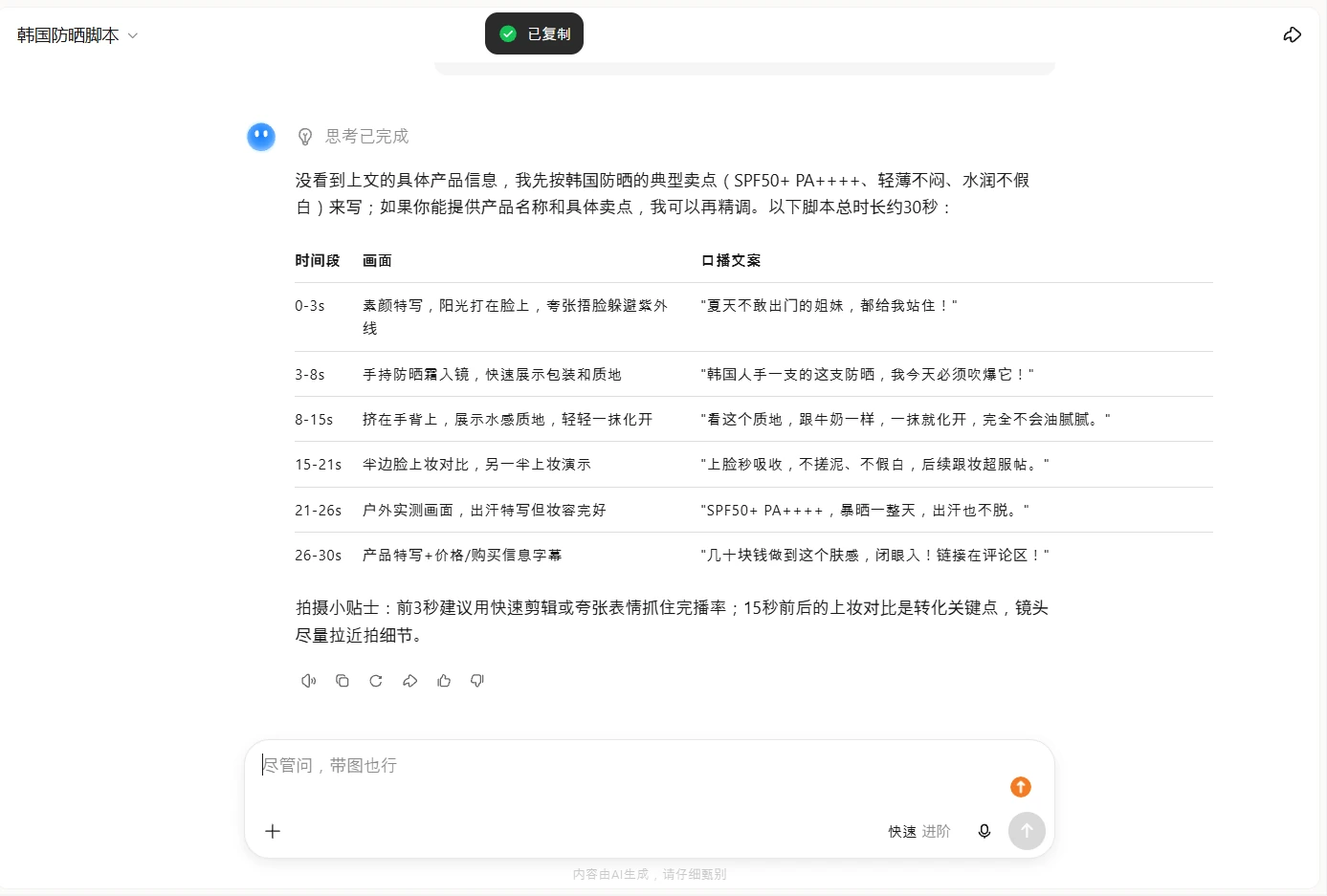
The prompt asked for a 30-second script in the “时间段|画面|口播文案” format. All three services kept a six-row table, from the 0–3 second opening to the closing shot.
After the table, Doubao added five shooting and editing tips and an unsolicited three-line compliance note: show the special-cosmetics registration number in product close-ups, avoid wording such as “晒不黑” and “零负担”, and mark the post as advertising if it is a commercial promotion. Kimi’s spoken lines included wording such as “韩国人手一支”, “必须吹爆”, “暴晒一整天,出汗也不脱” and “闭眼入” — absolute or efficacy-guaranteeing phrases. This script, too, was produced in a new conversation, without the earlier product details. The table format alone is not enough; the spoken lines still need a human pass.
The regulation query produced different document lists, and sources were shown differently

The sensitive-skin labelling question was the same as in part 1. Doubao’s “豆包工作” web screen has no button for turning web search on or off; only “自动” is shown. Once the reply appeared, source names were attached at the ends of sentences, so the model had searched automatically. Kimi’s screen also had no search toggle, but source links were attached to the reply, so search had run.
The same question was refused once in Doubao, with the line “抱歉,我无法回答你的问题”. Entered again in a new conversation, it produced an answer. If a query is refused, it is often better to start a new chat than to repeat the question in the same thread.
Doubao’s reply carried 23 in-text source marks, from 14 unique sources, mostly government sites such as the National Medical Products Administration and the State Administration for Market Regulation. Those marks do not reveal a URL, and copying the reply with “复制” drops them. DeepSeek attached six citation links (four unique URLs), and the screen showed “搜索到 9 个网页”. Kimi attached 12 links (12 unique URLs), and the addresses were readable. Three of those sources were government sites, and documents from 2010 and 2020 were mixed in.
The three services named different documents. Among those Doubao cited, the official pages confirm the titles and dates of the NMPA Announcement on Matters Concerning Cosmetics Registration and Filing (2026 No. 70, posted 29 July 2026) and the national standard GB 7916—2026, General safety requirements for cosmetics (published 30 July 2026, effective 1 January 2028). Neither document appeared in Kimi’s reply. Which list to follow cannot be decided from the model answers alone; the official texts have to be opened and read.
Qwen and Doubao API prices are from official documents only
Fees and terms for Qwen, Doubao’s Volcano Engine Ark and BytePlus ModelArk API prices, and the Kimi API price list, were copied from official price pages opened on 26 November 2026 and are set out in part 1. They are not results from using those APIs. Prices change often, so the official pages should be opened again before any use.
On the official documents alone: the Kimi API (platform.kimi.ai) is pay-as-you-go and is a separate product from Kimi Membership and Kimi Code. A minimum top-up of $1 is required to start, and a $5 voucher is issued when cumulative top-ups reach $5. Qwen’s free allowance of 1 million tokens per model for 90 days applies only in the Singapore region of Alibaba Cloud Model Studio. Doubao’s China API is priced in yuan on Volcano Engine Ark; the overseas channel is BytePlus ModelArk, priced in US dollars. The figures themselves are in the table in part 1.
What to check before posting a draft as-is
The same prompt can still produce different title angles, tag counts, and different places for the price and English name. First-person notes may invent usage scenes that were not in the brief. “第一” and “最” should be read in context, not only counted, and wording outside the banned list — “极致裸感”, “必须吹爆”, “闭眼入”, “韩国人手一支” — still needs a human pass. Character counts the model writes next to a Tmall title may not match the real length, and a word such as “美白”, which belongs to a special-cosmetics efficacy that requires registration, can appear even when it was not in the brief. Review-label totals the model writes can disagree with the labels themselves, so they should be counted again. Regulation answers name different documents from one service to the next, and source marks can disappear when a reply is copied. A question that is refused once may still be answered in a new conversation. Scripts and titles written without the earlier product details should not be treated as a same-condition comparison.
Sources: CMB test (27 November 2026, Doubao web chat “豆包工作”, DeepSeek web chat and Kimi web chat in “快速” mode, the same Xiaohongshu notes, 50 reviews, Tmall titles, Douyin script and regulation-search prompts) · Regulations on the Supervision and Administration of Cosmetics (State Council Decree No. 727) · NMPA Announcement 2026 No. 70 · GB 7916—2026 · Kimi Recharge and Rate Limiting · Alibaba Cloud Model Studio pricing · Volcano Engine Ark model pricing · BytePlus ModelArk Pricing · The detailed fee table is in China AI marketing guide, part 1 (pages opened on 26 November 2026)