The Swatch Art Peace Hotel on Shanghai's Bund, Nov 27, 2025. Photo: Supanut Arunoprayote, Wikimedia Commons, CC BY 4.0.
Swiss watches, coffee and machine tools are set to lose their Chinese import tariffs, but not yet. China and Switzerland signed a protocol upgrading their 2013 free trade agreement in Beijing on Oct 30, 2026, and it only takes effect after both sides finish their domestic approval procedures. No date has been set. (MOFCOM, Oct 30, 2026)
Unless marked otherwise, everything below comes from that statement by China's Ministry of Commerce (MOFCOM).
What was signed
- Who signed: Commerce Minister Wang Wentao and Swiss State Secretary Helene Budliger Artieda, with Chinese President Xi Jinping and Swiss President Guy Parmelin looking on.
- The deal it upgrades: the 2013 FTA, which MOFCOM describes as China's first with a country in continental Europe.
- How much trade is involved: US$49.04 billion in 2025. That makes Switzerland China's 7th-largest trading partner in Europe, while China is Switzerland's largest in Asia.
- What changes: 8 existing chapters are updated and 2 are added, one on digital trade and one on trade and sustainable development.
The tariff cuts consumers will notice
Each side will cut tariffs on nearly 300 more tariff lines. When the cuts are fully phased in, more than 99% of bilateral trade will be tariff-free.
China will get there in one of three ways: some tariffs drop to zero straight away, others over a 5-year or 10-year transition. Coffee, machine tools and watches are the Swiss products MOFCOM singles out. Under the 2013 deal they got only partial cuts or none at all; now their tariffs are to be "gradually eliminated".
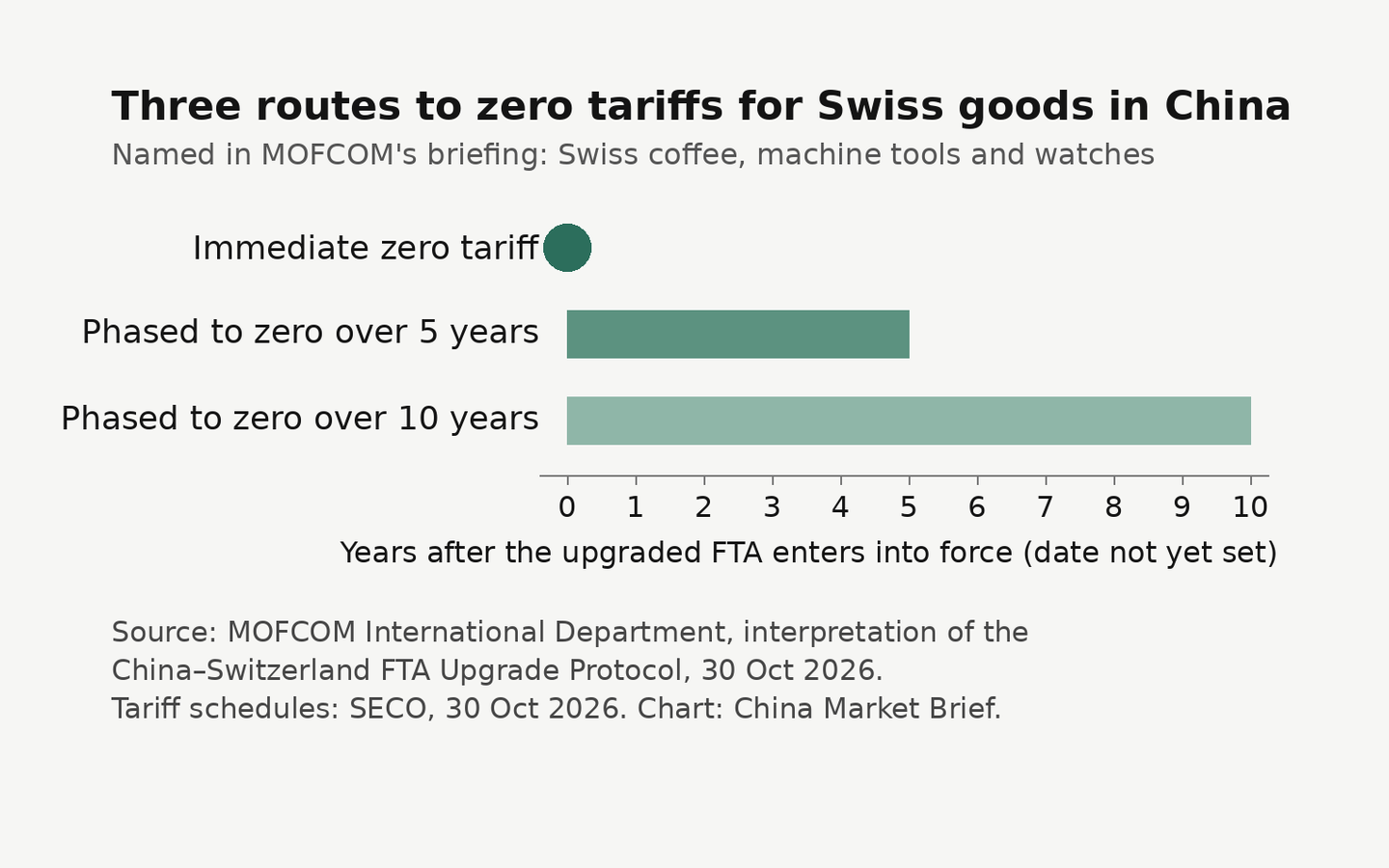
The three phase-out routes MOFCOM describes. The ministry has not said which route applies to which product. Chart: China Market Brief, based on MOFCOM.
What is not known yet: which of the three routes watches or coffee will take, and what the current and final rates are. MOFCOM's statement gives neither. The answer sits in the product-by-product schedules. Switzerland's State Secretariat for Economic Affairs (SECO) has already published China's tariff schedule alongside the signed protocol (SECO), and MOFCOM says it will post the text on its China FTA Network (fta.mofcom.gov.cn). This brief does not yet go through the rates line by line.
Switzerland, for its part, already scrapped all tariffs on industrial goods under the original deal. This time it is opening up farm imports, which MOFCOM calls the most liberal market access Switzerland has ever offered. Chinese oilseeds, vegetable oils and pet food are the products it names.
Beyond tariffs
- Digital trade: no customs duties on electronic transmissions, stronger personal-information protection and a move to fully digital customs clearance. MOFCOM says it is the first time China has put a dedicated source-code protection clause into a bilateral FTA.
- Customs: new rules on a single window and on releasing goods, including fast clearance for perishables.
- Rules of origin: some product-specific rules now allow more non-originating material, so the preferential rate is easier to claim.
- Cooperation: watches and clocks (钟表) are a named area of economic and technical cooperation, alongside agriculture, traditional Chinese medicine, supply chains and SMEs.
Also this week: China–Peru upgrade takes effect Nov 1
Unlike the Swiss deal, this one has a date. At MOFCOM's Oct 29 press conference, spokesperson Huang Ling confirmed that the upgraded China–Peru FTA protocol takes effect on Nov 1, 2026, after Peru issued a decree on Oct 27. The protocol was signed in November 2024. (MOFCOM press conference, Oct 29, 2026)
What to watch
- The tariff schedules. SECO's copy is already out and MOFCOM's is due on fta.mofcom.gov.cn. They are where you will find which route watches, coffee and other products follow.
- Entry into force. It waits on both countries' domestic approvals. No date has been announced.
- The import expo. The 9th China International Import Expo runs in Shanghai on Nov 5–10 (MOFCOM), the next public stage for imported consumer brands.
Related reading: for how China's consumer trade-in subsidies have moved sales, see China's Trade-In Subsidy Program Drives Over 2 Trillion Yuan in Sales, and for the pricing rules that apply during this year's shopping festival, see Singles' Day 2026 Discounts: China's 7-Day Lowest-Price Rule and a Brand Checklist.
Sources checked Oct 31, 2026 (KST). All figures come from MOFCOM releases; no estimates have been added.
Get China Market Brief updates by email: subscribe here for new trade and consumer-market briefs.